Testing Service

SOIL & AGGREGATE PHYSICAL & STRENGTH TESTING

We evaluate soil and aggregate materials to determine engineering properties essential for foundations, pavements, and earthwork design.

12
Test Types
9
States Served
Overview

ABOUT OUR SOIL & AGGREGATE PHYSICAL & STRENGTH TESTING

Soil and aggregate testing measures the physical properties and the strength of the natural soil beneath a project and of the sand, gravel and crushed stone used to build on it. Physical properties describe what the material is: its particle sizes, plasticity, moisture and density. Strength properties describe what it can do: how much load it can carry before it fails or settles.

Together, these results tell engineers whether a site can support a foundation, pavement or embankment, and whether a construction material meets its specification. Nearly every earthwork project starts with this testing, and the tests below are what fall under it.

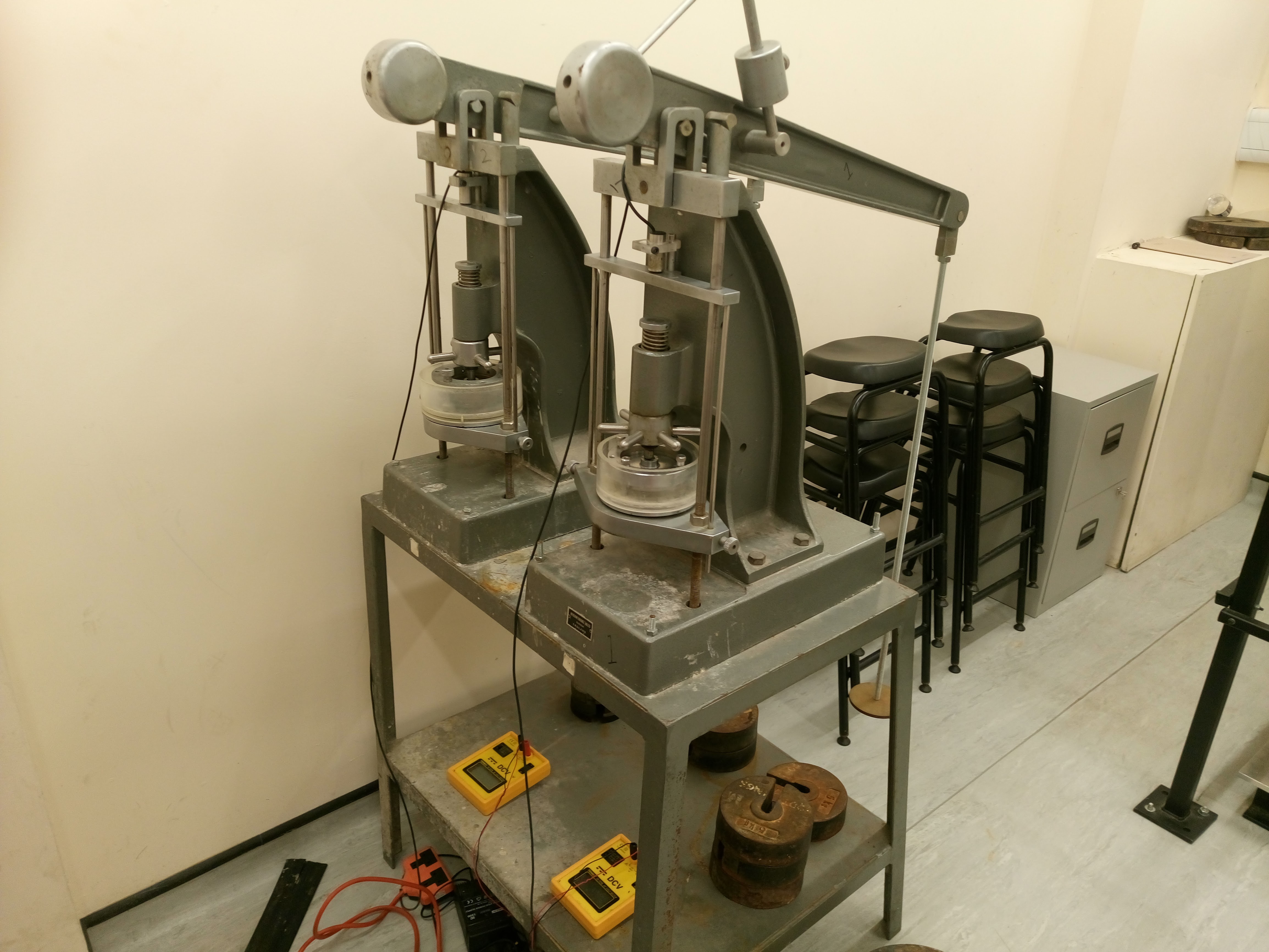
Laboratory consolidation test apparatus used for soil testing
Commonly Used For
  • Foundation design
  • Pavement subgrade and base design
  • Earthwork and fill control
What Falls Under It

WHAT'S INCLUDED

01

Grain Size Analysis (Sieve & Hydrometer)

ASTM D6913 / D7928

Grain size analysis determines the proportions of gravel, sand, silt and clay in a soil. Coarse particles are separated on a stack of sieves, and the finer silt and clay fraction is measured with a hydrometer as the particles settle in water. The resulting curve is used to classify the soil and to predict behavior such as drainage.

02

Atterberg Limits

ASTM D4318

The Atterberg limits are the moisture contents at which a fine-grained soil changes from liquid to plastic (the liquid limit) and from plastic to semi-solid (the plastic limit). The difference between them is the plasticity index. These values classify clays and silts and indicate how much a soil will swell, shrink or lose strength when its moisture changes.

03

Standard & Modified Proctor Compaction

ASTM D698 / D1557

Proctor tests find the relationship between a soil's moisture content and its dry density when it is compacted with a set amount of effort. The peak of that curve gives the maximum dry density and the optimum moisture content, which become the targets for compaction in the field. The Standard test uses a lighter compaction effort and the Modified test uses a heavier one, for projects carrying higher loads.

04

California Bearing Ratio (CBR)

ASTM D1883

The California Bearing Ratio measures the strength of a compacted soil or base material by pushing a standard piston into it and comparing the load to that of a reference crushed stone. Higher values mean a stronger material. The result is widely used in pavement design to size the thickness of the base and subbase layers.

05

Direct Shear and Triaxial Shear Tests

ASTM D3080 / D4767

Shear strength tests measure how much stress a soil can take before it slides or fails. In direct shear, a sample is forced to slip along a set plane. In triaxial testing, a cylindrical sample is confined under pressure and loaded until it fails. Both give the cohesion and friction angle used to design foundations, retaining walls and slopes.

06

Unconfined Compressive Strength (UCS)

ASTM D2166

Unconfined compressive strength is a quick strength test for cohesive soils. A cylindrical sample is loaded vertically, with no confining pressure, until it fails, and the peak stress is the result. It gives a fast estimate of how strong and how stiff a clay soil is.

07

Specific Gravity and Moisture Content

ASTM D854 / D2216

Moisture content is the weight of water in a soil compared with the weight of its solid particles, and it influences almost every other property, including strength and compaction. Specific gravity is the density of the soil particles relative to water. Both are basic measurements that other calculations, such as void ratio and the hydrometer analysis, depend on.

08

Relative Density

ASTM D4253 / D4254

Relative density describes how tightly packed a sand or gravel is compared with its loosest and densest possible states. The laboratory determines those two limits, and the result is compared with the density in the ground or in the fill. It is used to judge how well a granular soil has been compacted and how it will behave under load.

09

Consolidation Tests

ASTM D2435

Consolidation testing measures how much a saturated clay compresses over time when a load is applied, and how quickly that settlement happens. A sample is loaded in stages inside a rigid ring while its change in height is recorded. Engineers use the results to predict how much a building or embankment will settle, and over what period.

10

Aggregate Gradation

ASTM C136

Aggregate gradation is the distribution of particle sizes in a sample of sand, gravel or crushed stone, measured by shaking it through a stack of sieves. Gradation controls how well the particles pack together, which affects the strength, workability and stability of concrete, asphalt and base courses. Results are compared against the limits in the project specification.

11

Aggregate Abrasion

ASTM C131

Abrasion testing measures how well coarse aggregate resists wear and breakdown. The sample is tumbled in a rotating drum with steel spheres, and the percentage of material worn away is reported. Aggregate that breaks down easily is a poor choice for pavements and other surfaces that carry heavy traffic.

12

Aggregate Soundness

ASTM C88

Soundness testing evaluates how well aggregate stands up to weathering, particularly freezing and thawing. The sample is soaked repeatedly in a sulfate solution, which forms crystals in the pores in a way that imitates weathering forces, and the percentage lost is measured. It helps identify aggregates likely to deteriorate over time in exposed conditions.

Methods shown are the governing ASTM / AASHTO standards. If your project specifies a different standard or a state DOT method, tell us and we'll confirm.

Process

HOW IT WORKS

01

Tell us about your project

Share the tests you need, the specifications that apply, and your timeline.

02

We confirm the scope

We review the requirements with you and confirm the tests, standards and sample needs.

03

Testing in our lab

Your samples are tested in our Norcross, Georgia laboratory.

04

Receive your report

Reports can be ready in as little as 48 hours, depending on the test.

NEED SOIL & AGGREGATE PHYSICAL & STRENGTH TESTING?

Tell us about your project and we'll help you choose the right tests.

6500 McDonough Dr, Suite E-04, Norcross, Georgia 30093
Mon–Sat: 7am – 4pm
SSN Material Testing

Independent material testing laboratory delivering accurate and reliable results for construction projects across South Atlantic States.

Contact Us

Quick Links

Follow Us

Follow us on social media for updates, project highlights, and company news.

© 2026 SSN Material Testing. All rights reserved.